What is the Fez Mellah?
The Fez Mellah is the walled historic Jewish quarter of Fez, located in Fez el-Jdid beside the Royal Palace (Dar al-Makhzen). Founded in 1438, it is the oldest mellah in Morocco – the original Jewish quarter whose name spread to every other in the country.
The word mellah comes from the Arabic for salt, and the Fez quarter is where the name began. For centuries, this was the heart of Moroccan Jewish life.
Under the sultan’s protection, the community grew into a leading centre of scholarship, commerce and religious life. The quarter sat close to the royal palace by design – proximity that offered both protection and a measure of royal control over the artisans and merchants who lived there.
One distinction matters, and it’s easy to get wrong:
The walled mellah dates to the 15th century, but Jews had lived in Fez far longer – since roughly the 9th century, when the city was founded. The community is older than the quarter that came to house it.
What makes the Fez Mellah unique?
The Fez Mellah stands out as Morocco’s oldest Jewish quarter, with narrow streets, historic synagogues, and a hillside cemetery. Its outward-facing balconies – an Andalusian influence – set its houses apart from the inward-facing homes of the rest of the medina.
The mellah’s character is visible in its architecture. Where the Muslim medina turns inward – blank walls, hidden courtyards – many mellah houses open outward, with balconies and windows facing the street. Visitors notice them immediately.
Worth one honest note – this outward-facing style is a later feature, not original to 1438. The oldest mellah houses were closed-off like their Muslim counterparts; the ornate street-facing balconies came in over time, and the French road-building of the 1920s added a row of especially decorative ones.
The Andalusian influence is real, but the balconies belong to the quarter’s evolution, not its founding.
What is the history of the Fez Mellah?
Founded in 1438, the Fez Mellah is Morocco’s oldest Jewish quarter. Under the sultan’s protection, it became the country’s leading centre of Jewish scholarship and commerce, holding that role for centuries, before 20th-century emigration reduced the community.
The mellah did not appear in a single day. Jews had lived in Fez since the city’s founding, mostly in the old medina, Fes el-Bali. In 1438, the community was moved to a new walled quarter beside the royal palace in Fes el-Jdid – the move triggered by the rediscovery of the tomb of the city’s founder, after which the old city was declared holy ground and Jews were required to leave.
Some sources tie the 1438 founding to the Sephardic expulsion from Spain – but that expulsion came in 1492, more than fifty years later.
The Spanish exiles were a later wave that swelled the quarter; they were not the reason it was created.
Key moments in the history of the Fez Mellah and its Jewish community
| Date | Event |
| ~9th century | Jewish community established in Fez, around the city’s founding |
| 12th century | Persecution under Almohad rule; Jews forced to convert or leave |
| 1438 | The mellah founded – Jews moved from Fes el-Bali to a walled quarter in Fes el-Jdid |
| 1465 | The mellah is attacked during a revolt; the community rebuilds |
| 1492 | Jews expelled from Spain arrive in Fez, enlarging the community |
| 20th century | Large-scale emigration to Israel, France and Canada empties the quarter |
Sources: Calvo-Serrano et al, “Mellah: The Jews Quarter at the Medinas of Morocco. A New Interpretation of the Minority's Space in The Islamic City,” Procedia Engineering; Miller et al, 2001, “Inscribing Minority Space in the Islamic City: The Jewish Quarter of Fez (1438-1912),” Journal of the Society of Architectural Historians
Who lived in the Fez Mellah?
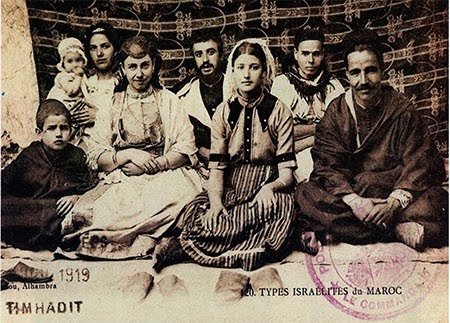
The Fez Mellah was home to a Jewish community with roots in the city reaching back to around the 9th century, settled in the walled quarter from the 15th century onward. At its height it housed several thousand people, including scholars, rabbis and merchants who made Fez a centre of Jewish learning.
At its height the quarter was a town within a town – with its own synagogues, schools, ovens and courts. In the late 1940s, before mass emigration, the mellah housed roughly 15,000 Jews, part of a city-wide Fez Jewish population of around 22,000.
The community split for generations between the Megorashim, Sephardic families of Spanish origin, and the Toshavim, the older Moroccan Jews — two groups who worshipped separately before eventually blending.
Is the Fez Mellah the oldest in Morocco?
Yes, founded in 1438, the Fez Mellah is the oldest Jewish quarter in Morocco – the first of its kind. Marrakech’s mellah followed more than a century later. Jews had lived in Fez since around the 9th century, long before the walled quarter itself was built.
Fez came first, and its name travelled. Every mellah in Morocco takes its name from this original quarter. Marrakech’s – the country’s second oldest – was created in the mid-16th century.
What happened to the Jews of Fez?
The community thrived for centuries, suffered periods of persecution, and declined sharply in the 20th century. Waves of emigration to Israel, France and Canada left only a small community in Fez today.
The fuller story of why Morocco’s Jews left is its own subject. In Fez, the quarter that once held thousands is now home to only a small number, and its houses are lived in mostly by Muslim families today.
What are the Jewish sites in Fez Mellah?
The main Jewish sites in the Fez Mellah are the Ibn Danan Synagogue, the Slat al-Fassiyine Synagogue, and the historic Jewish cemetery – among the oldest in Morocco. Together they preserve the heritage of a community that made Fez a centre of Jewish life for centuries.
These are the places I take travellers to, and they anchor any visit to the quarter. You'll find them among the wider best Jewish sites in Morocco, and among Morocco's historic synagogues.
The main Jewish heritage sites in the Fez Mellah – what each one is, and why it’s worth visiting.
| Site | What it is | Why visit |
| Ibn Danan Synagogue | A 17th-century synagogue, restored and reopened in 1999 | Zellij tiles, carved stucco and a painted wooden ceiling; one of Morocco’s best-preserved historic synagogues |
| Slat al-Fassiyine Synagogue | Reputed to be the oldest synagogue in the mellah, restored in 2013 | The original synagogue of the Toshavim, the older Moroccan-Jewish community |
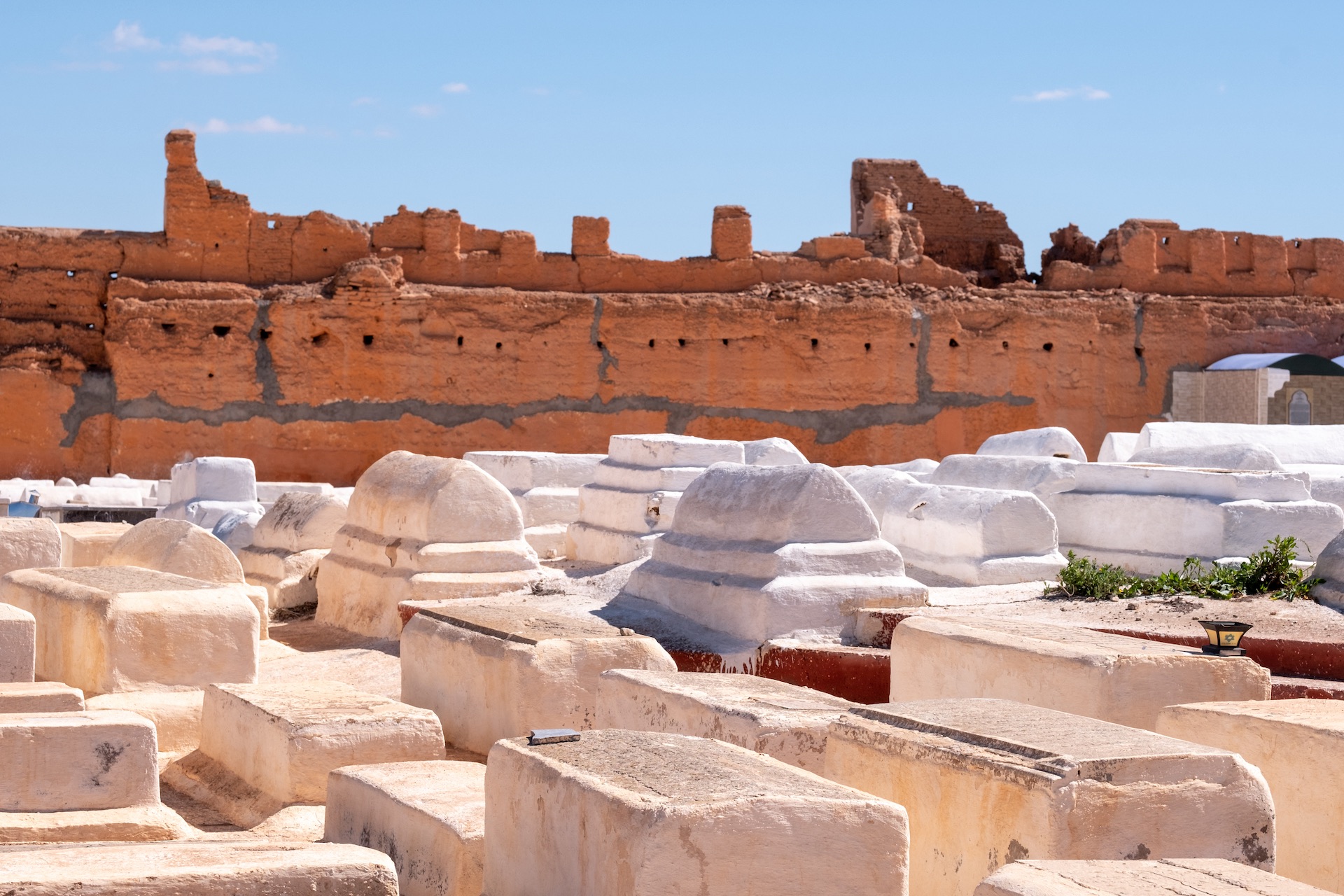
| The Jewish Cemetery (Beit Hachaim) | A hillside cemetery of white tombs at the southern edge of the mellah | Around 22,000 graves, including revered rabbis – a striking, peaceful contrast to the medina |
| Bab Mellah & the markets | The gate and market streets of the quarter | Enter through Bab el-Mellah onto Derb al-Souq, the main market street, still lined with local commerce |
Sources: World Monuments Fund, “Rabbi Shlomo Ibn Danan Synagogue”; Palais Faraj, “The Mellah of Fez”; Miller et al, “Inscribing Minority Space in the Islamic City: The Jewish Quarter of Fez (1438-1912),” Journal of the Society of Architectural Historians.
Ibn Danan Synagogue
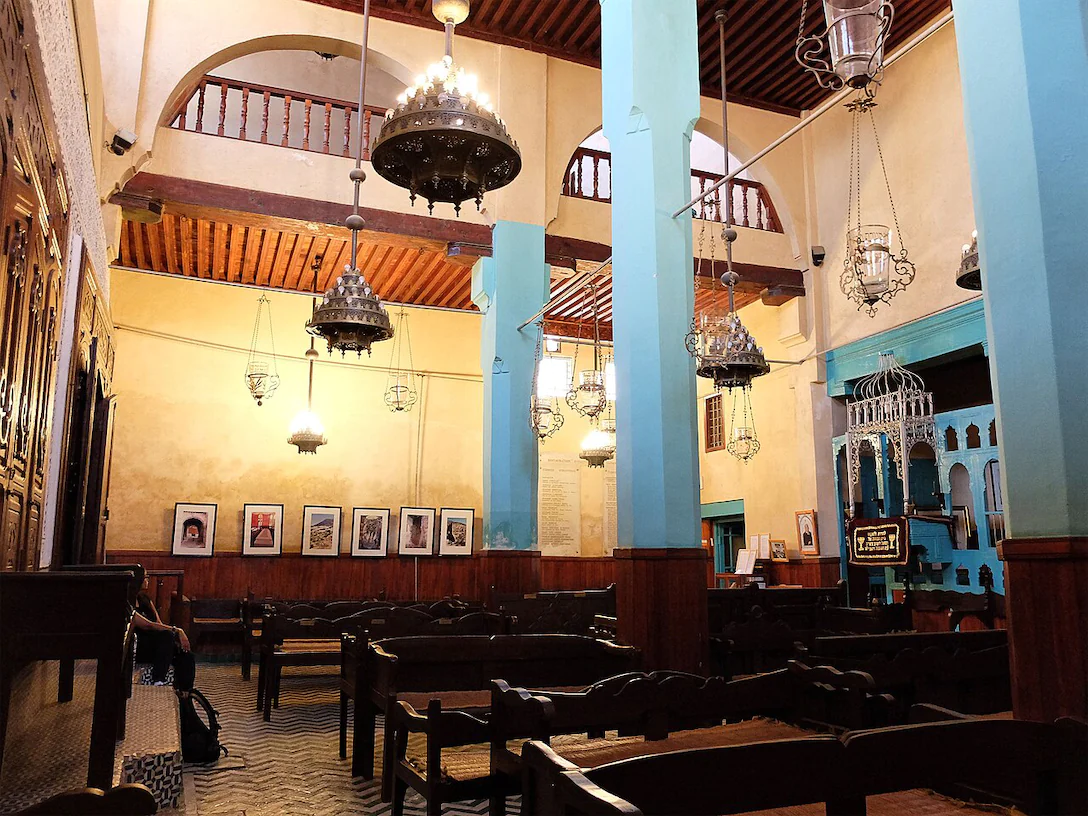
The Ibn Danan Synagogue is the quarter’s best-known house of worship. Established in the 17th century – rebuilt around 1701, in keeping with a mellah where synagogues were repeatedly restored on the same sites – it is named after the Ibn Danan family, whose rabbis led it from 1812 until the 1960s.
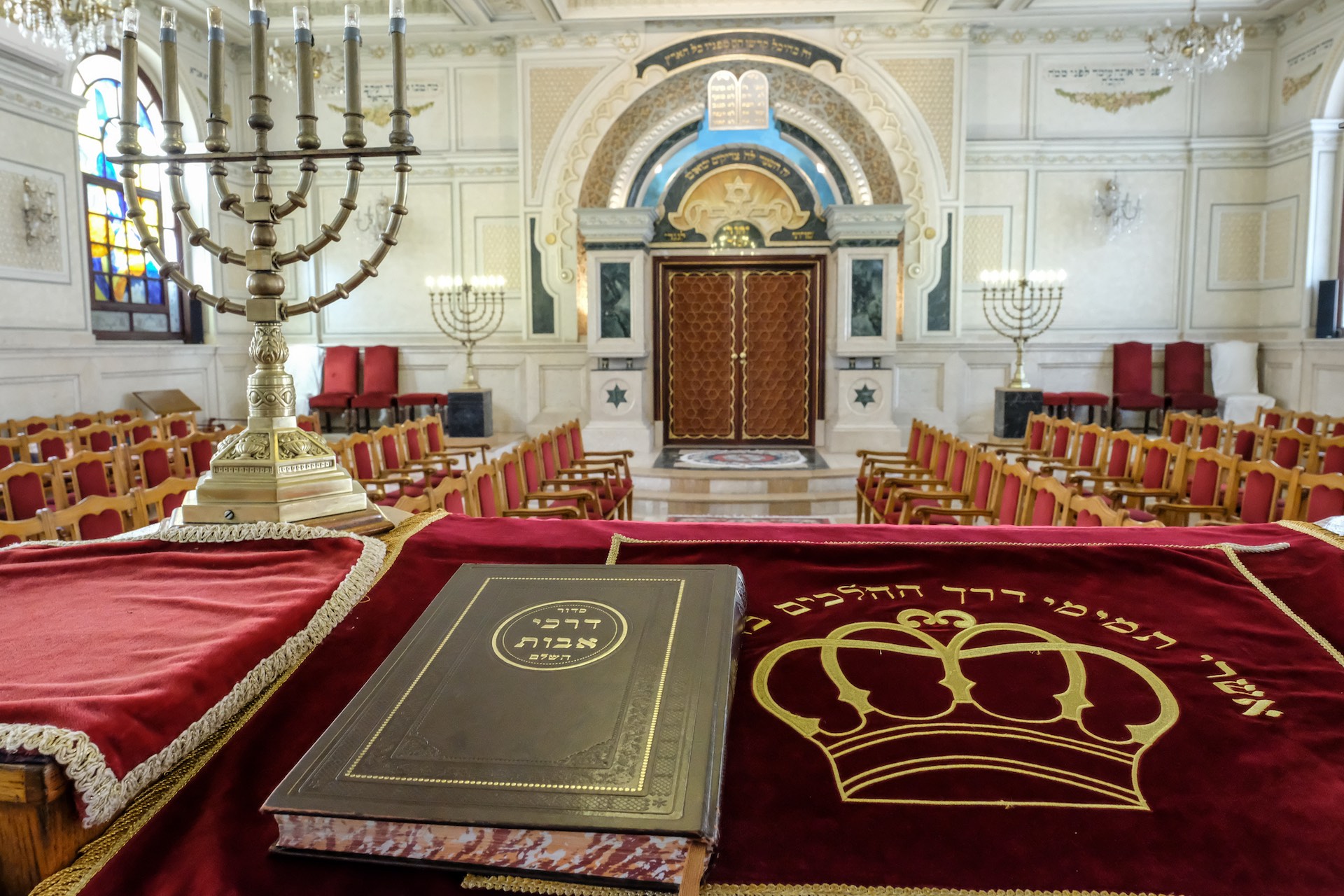
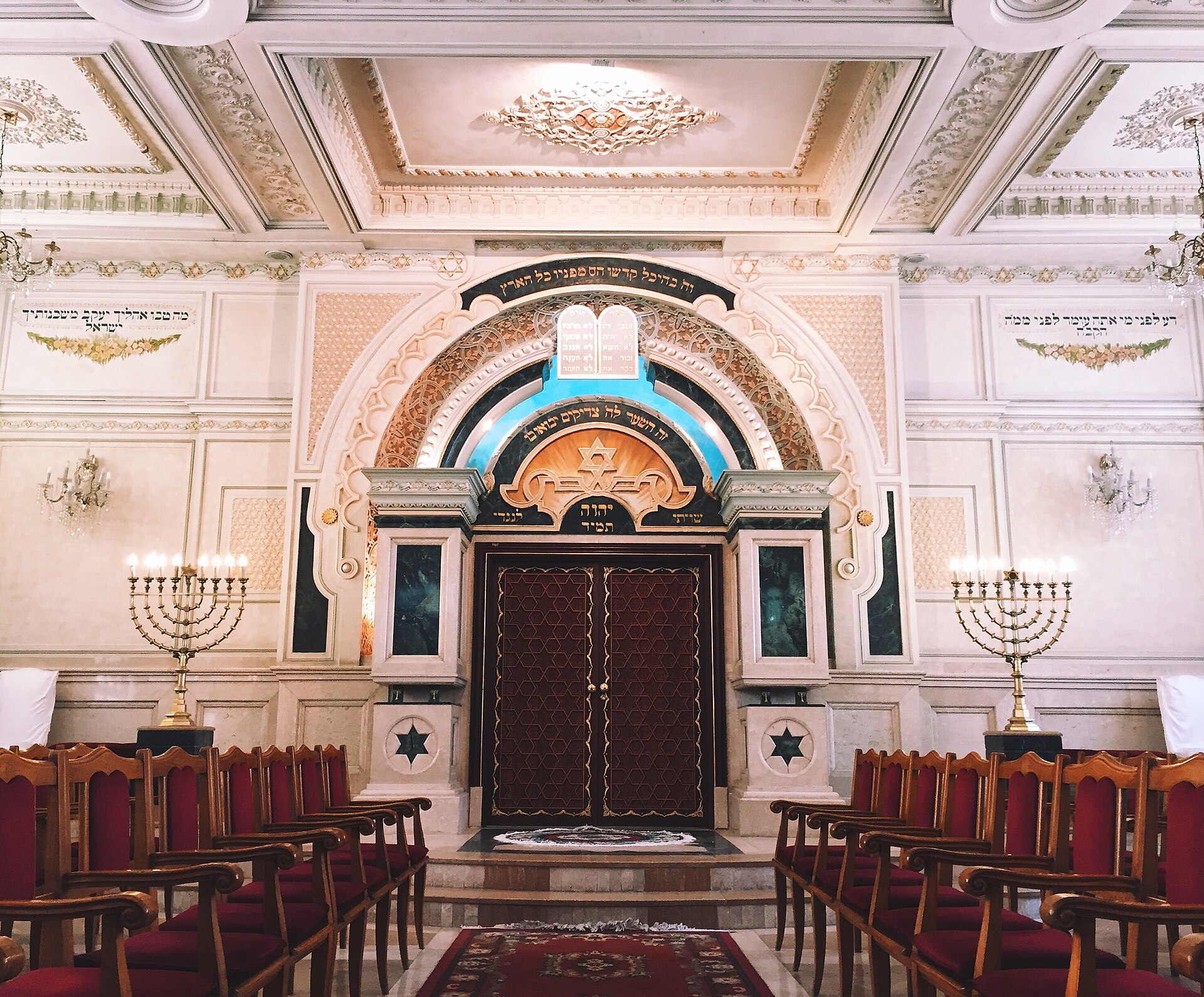
Inside are green and white zellij tiles, carved stucco around the Torah ark, a painted wooden ceiling, and an elevated bimah crowned with a wrought-iron canopy. The building was conserved by the World Monuments Fund in 1996, working with Morocco’s Ministry of Culture and the Judeo-Moroccan Cultural Heritage Foundation, and reopened to the public in 1999.
Slat al-Fassiyine Synagogue
The Slat al-Fassiyine is reputed to be the oldest synagogue in the mellah, possibly dating to the Marinid period. It served the Toshavim – the indigenous Moroccan Jews – and kept their non-Sephardic rituals alive longer than most.
After decades of disrepair, it was restored in 2013.
The Jewish Cemetery (Beit Hachaim)
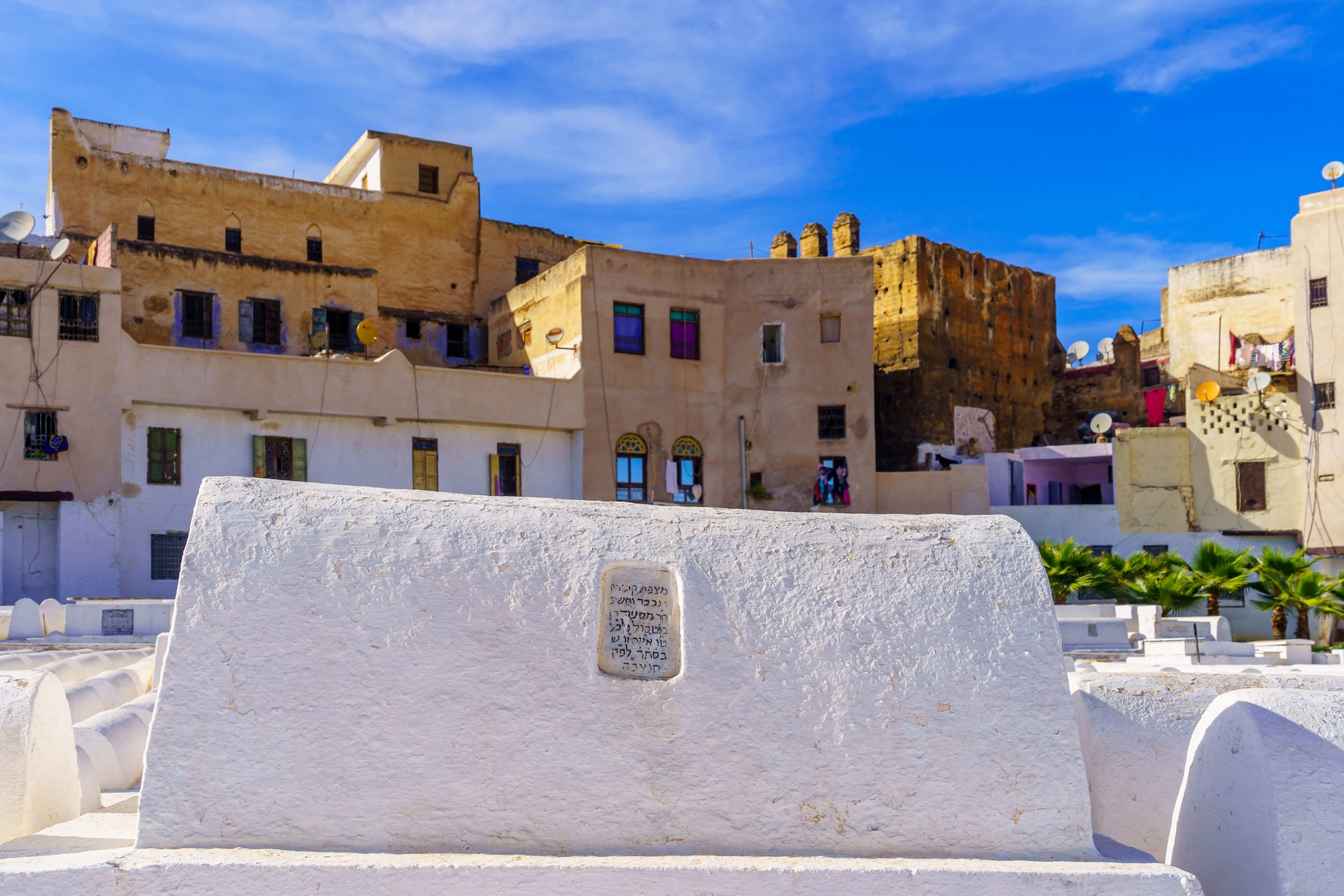
The Jewish cemetery sits at the southern edge of the mellah, its rows of whitewashed, sun-bleached tombs terraced across the hillside. It holds around 22,000 graves, among them the tombs of revered rabbis. Rabbi Yehuda Ben Attar (d. 1733), a chief rabbi of Fez, is the focus of a major annual pilgrimage.
One of our best local Moroccan guides, Youssef Sebti, is a personal friend of the guardian of the Fez Cemetery and can provide our private Jewish tour clients exclusive access and insights.
Bab Mellah & the markets
The quarter is entered through Bab el-Mellah (Mellah Gate), the gate that historically marked its official entrance. From there Derb al-Souq, the main market street, runs through the mellah – once its commercial spine, still lined with shops and everyday trade today.
How do you visit the Fez Mellah?
The Fez Mellah sits in Fes el-Jdid, beside the Royal Palace, and is reached on foot from the medina. A guided tour adds context to its history and sites. Allow time for the Ibn Danan Synagogue and the nearby cemetery, and dress modestly at active religious sites.
The mellah is walkable and easy to reach – it sits right beside the Royal Palace in Fes el-Jdid, a short distance from the old city. A guide brings the quarter’s layers to life, and it’s the kind of place where the history is easy to miss without one.
What stays with most travellers is that the mellah is still a living place. Descendants of Fez’s Jewish families return to trace their roots, and the local families who live here now often welcome visitors in. On a guided visit you can find yourself invited for tea, hearing the story of a house and the people who once filled it.
For travellers who want to go deeper, we build these visits into wider private Jewish heritage tours of Morocco.
Frequently Asked Questions
Where is the Fez Mellah?
The Fez Mellah is in Fes el-Jdid (“New Fes”), the walled district beside the Royal Palace, distinct from the older Fes el-Bali medina. It is easily reached on foot within the old city.
Is there still a Jewish cemetery in Fez?
Yes, a Jewish cemetery still stands at the southern edge of the Fez Mellah. Though the Jewish population has dwindled, the cemetery remains a significant heritage site, with graves reflecting more than five centuries of Jewish presence in the city.
How many Jews are in Fez, Morocco?
Around 150 Jews are estimated to remain in Fez today, according to the World Jewish Congress. The city once had a far larger community that shaped its cultural and economic life for centuries before 20th-century emigration.
Is there a Jewish museum in Fez?
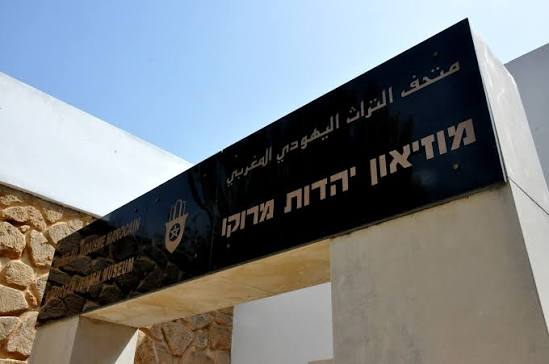
A Museum of Jewish Culture has been built in the mellah district of Fez, completed in 2023. Unfortunately, the museum is not yet open to the public.
Alongside it, the quarter preserves the city’s Jewish heritage through living sites – the Ibn Danan and Slat al-Fassiyine synagogues and the historic cemetery.
Is the Fez Mellah worth visiting?
Absolutely – as Morocco’s oldest Jewish quarter, the Fez Mellah rewards anyone interested in the country’s Jewish heritage, with its synagogues, historic cemetery and distinctive Andalusian-influenced architecture. It offers a quieter, historically rich contrast to the busier medina.
Walk the Fez Mellah With Shin Tours
I’ve spent over twelve years organizing private Jewish tours of Morocco – and the Fez Mellah is where the story starts. As the country’s oldest Jewish quarter, it holds centuries of Moroccan Jewish life – the synagogues, the hillside cemetery, and streets shaped by the families who settled here. My team and I know these places and the people who still care for them.
When you request a free custom itinerary, you get:
- A tailored itinerary built around your interests and travel group
- A personal call with me to talk through your trip
- A sample itinerary to review before you commit
Request your free custom Morocco itinerary, and let’s plan a journey into a heritage that’s still very much alive.
Why not just visit the Mellah on my own?
You can – the quarter is open and walkable. But much of its history is invisible without someone to read it – which synagogue is which, whose tombs line the cemetery, which doorway hides a story.
A guide is the difference between a pleasant walk and understanding what you’re seeing.