You can walk the whole of Rome’s Jewish quarter in ten minutes and miss nearly all of it. The synagogue needs paperwork filed before you fly, the brass stones underfoot carry names, and very little of what you are looking at is labeled for a visitor.
Rome’s Jewish Ghetto holds seven sites worth a Jewish visitor’s time: the Great Synagogue, the Jewish Museum, the Tempio Spagnolo, Piazza delle Cinque Scole, the Portico d’Ottavia, the Casa di Lorenzo Manilio and Largo 16 Ottobre 1943. All stand in Rione Sant’Angelo, the quarter sealed off in 1555.
Here is what each one is, and what you have to arrange before you can get inside the ones that matter most.
What is the Jewish Ghetto in Rome?
The Jewish Ghetto of Rome is the walled quarter in Rione Sant’Angelo where the papacy confined the city’s Jews from 1555. Also called the Jewish Quarter, it ended as a legal institution on 20 September 1870, when the Papal States were absorbed into the Kingdom of Italy.
Pope Paul IV established it by the bull Cum nimis absurdum on 14 July 1555. The Jewish Community of Rome’s own history records 1,772 Jews living in the city in 1525, three decades before the quarter was sealed.
1870 is the legal end, and only that. The gates stopped being law that September. The buildings came down over the decades that followed, and the sources do not agree closely enough on when to give you a date.
The word itself is Venetian. It comes from “geto,” the foundry district where Venice confined its Jews in 1516 – thirty-nine years before Rome did the same. Rome’s is not the first.
You will see the place called both things. “Ghetto” is what the city and the community use. “Jewish Quarter” is the softer name that travel writing prefers. Neither is wrong, and locals use both.
If you are building a wider trip, the quarter is one stop among several: here are Jewish sites to visit across Italy.
Where is it, and is it part of Trastevere?
Rome’s Jewish Ghetto and Trastevere sit on opposite banks of the Tiber and are separate quarters. The Ghetto is Rione XI Sant’Angelo, on the left bank facing Tiber Island. Trastevere is Rione XIII, across the water on the right bank.
This one comes up constantly, usually because tours sell the two together. They are a short walk apart and they are not the same place.
The rione’s edges run along a ring of streets and squares – Largo Arenula to the west, Via delle Botteghe Oscure to the north, Lungotevere de’ Cenci along the river and Via del Teatro di Marcello to the east. If you want the full line, those are the rione’s official boundaries.
The municipality also names Piazza delle Cinque Scole, Via in Publicolis, Via del Portico d’Ottavia and the Casa di Lorenzo Manilio with its inscription referring to piazza Giudea. That short list is most of what people come for.
How big is the Ghetto, and can you walk it in one go?
Rome’s Jewish Ghetto is small enough to cover on foot in a single visit. The quarter runs a few blocks back from the Tiber, and its main sites – the Great Synagogue, the Portico d’Ottavia and Piazza delle Cinque Scole – stand within a short walk of each other.
A few blocks enclose it, and everything in this post sits inside them.
That compactness is why the quarter gets underestimated. People see the size, give it fifteen minutes on the way to somewhere else, and come away with photographs of a portico.
The distances are nothing; what takes the time is the synagogue, the museum, and reading what is written on the ground.
Which sites should Jewish visitors see in the Ghetto?
Seven sites in Rome’s Jewish Ghetto repay a Jewish visitor’s time: the Great Synagogue, the Jewish Museum, the Tempio Spagnolo, Piazza delle Cinque Scole, the Portico d’Ottavia, the Casa di Lorenzo Manilio and Largo 16 Ottobre 1943. Three of them share one building.
The following table lists the seven sites, what each one is, and what a Jewish visitor is actually looking at on the ground:
| Site | What it is | What's there now | Why it matters to a Jewish visitor |
|---|---|---|---|
| Tempio Maggiore (Great Synagogue) | Rome’s main synagogue, begun 1901 and inaugurated 29 July 1904 | A working synagogue by Osvaldo Armanni and Vincenzo Costa, under a square aluminum-clad dome | The community’s main house of prayer. You get in through advance registration, not by turning up |
| Museo Ebraico di Roma (Jewish Museum) | The Jewish Community of Rome's museum | Housed inside the synagogue building | Where the quarter’s surviving religious objects are kept, in the same building as the synagogue that replaced the Cinque Scole |
| Tempio Spagnolo | Spanish-rite oratory for the congregation descending from the 1492 expulsion | Moved into the Tempio Maggiore building in 1932, refurnished in 1948 | The 1948 refurnishing used marble salvaged from the Cinque Scole, so the Sephardi oratory is partly built from the older building |
| Piazza delle Cinque Scole | A square carrying the name of five rite congregations | An open square in the old quarter | The name records Scola Tempio, Scola Nova, Scola Siciliana, Scola Catalana-Aragonese and Scola Castigliana – five rites in one building, demolished between roughly 1888 and 1904 |
| Via del Portico d’Ottavia and the Portico | The Augustan portico dedicated to his sister, and the street running from it | The only surviving great Roman portico, with the marble slab still in place | The slab sets out which fish heads were owed to the Capitoline Conservatori – Rome’s fish market stood here until its demolition in the late nineteenth century |
| Casa di Lorenzo Manilio | A Renaissance house on Via del Portico d’Ottavia | Standing, with its inscribed facade | The inscription refers to piazza Giudea, the older name for the quarter |
| Largo 16 Ottobre 1943 | The square named for the round-up | A named square at the edge of the quarter | Where the annual memorial march finishes |
The Great Synagogue and the Jewish Museum
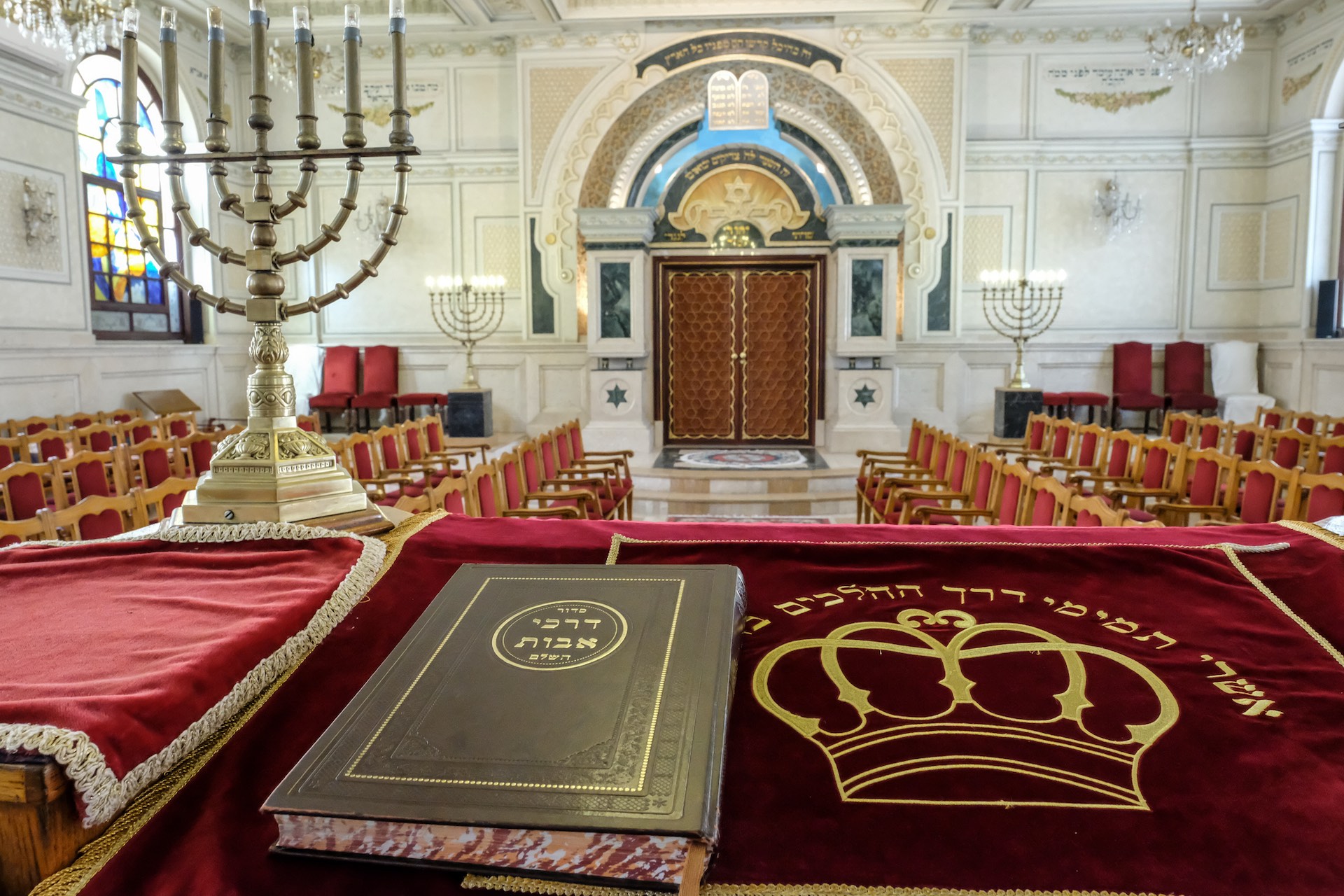
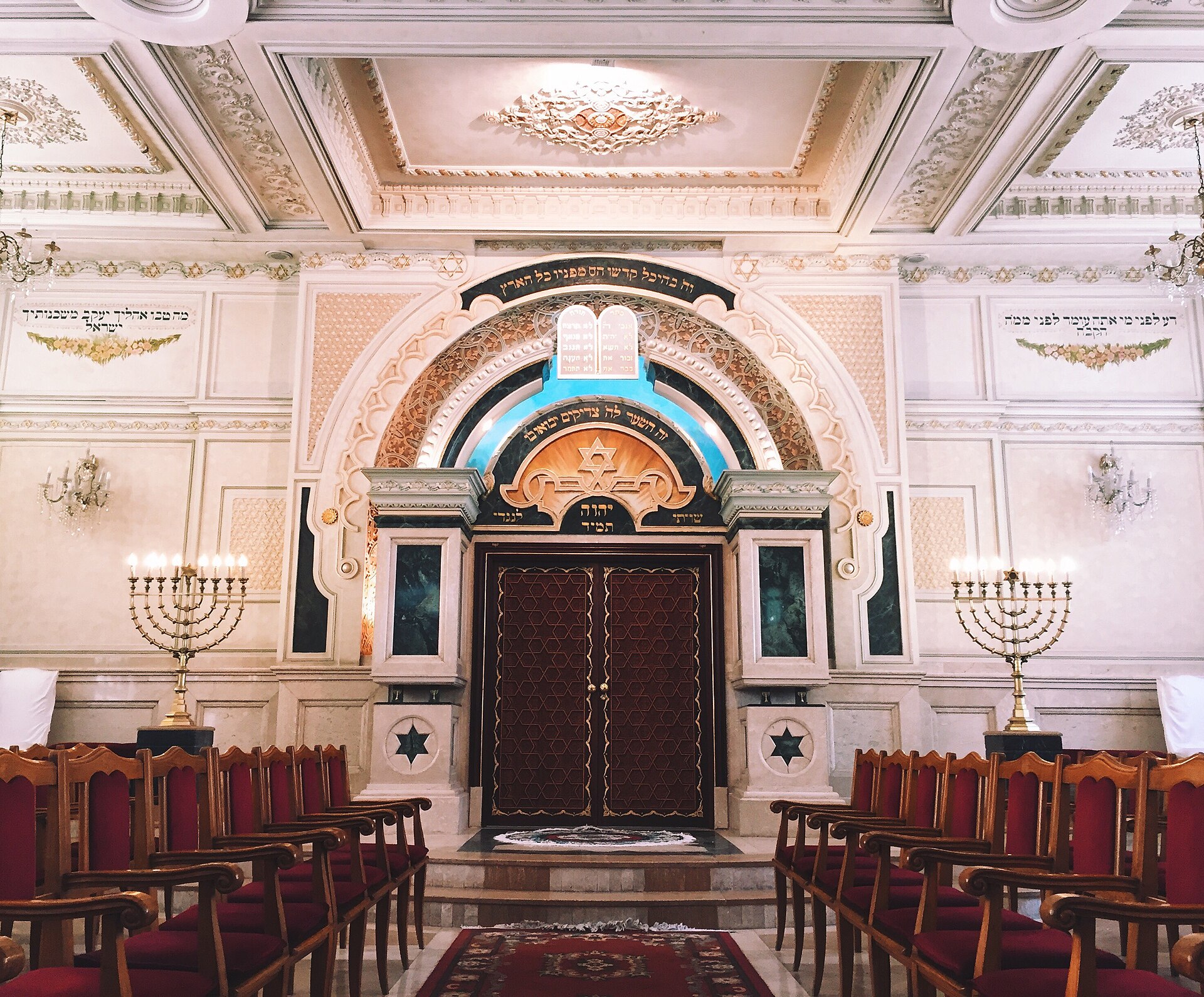
The Great Synagogue of Rome, the Tempio Maggiore, was begun in 1901 and inaugurated on 29 July 1904, to designs by Osvaldo Armanni and Vincenzo Costa. Its square dome is clad in aluminum. The Museo Ebraico di Roma sits inside the same building.
The dome is the thing people recognize from across the river. It is square, which almost nothing else in the Rome skyline is, and that is as far as anyone can honestly go – no official account explains the choice, whatever travel writing tells you.
The museum shares the building rather than sitting somewhere else in the quarter, which is what makes the visit efficient. You are in one place for both.
The Jewish Museum of Rome publishes its own information on what it holds. Go there rather than to a tour listing, because the listings are inconsistent on the museum’s layout and the museum is not.
Portico d’Ottavia and Piazza delle Cinque Scole
The Portico d’Ottavia is the Augustan portico dedicated to Augustus’ sister, and the only great Roman portico still standing. Piazza delle Cinque Scole, a short walk away, carries the name of five rite congregations that shared a single building.
Rome’s fish market ran here until the late nineteenth century. The marble slab recording which fish heads were owed to the Capitoline Conservatori is still in place, which is the detail most people walk straight past.
The square is the harder one to read. Its name preserves five congregations – Tempio, Nova, Siciliana, Catalana-Aragonese, Castigliana – who shared one building between them, and that building was demolished between roughly 1888 and 1904 to clear ground for the Tempio Maggiore.
The square carries the name. I can’t stand behind any source that puts the building itself on that square; I will not tell you it stood there.
What happened in the Ghetto in October 1943?
The round-up of 16 October 1943 took around 1,269 people from Rome, of whom around 252 were released as not Jewish; a train left on 18 October, with 1,020 aboard. 16 returned. The Jewish Community of Rome’s historical archive records these figures and states they cannot be final.
The 16 consisted of 15 men and one woman.
Those numbers are the community’s own, and I use them on purpose. Several bodies have counted this and their totals differ, so a post that blends them produces a figure nobody published. The Jewish Community of Rome’s historical archive sets out its own, with the caveat that they are not closed.
Those seized were held at the Collegio Militare on Via della Lungara before leaving from Tiburtina station.
The operation centered on the old Ghetto, but it ran through other districts of the city too; it was not confined to these streets.
Every year, a Marcia della Memoria walks from Piazza del Campidoglio to Largo 16 Ottobre 1943, with a ceremony at the Portico d’Ottavia. As the 2023 program set it out, it’s organized by Roma Capitale with the Jewish Community of Rome, the Fondazione Museo della Shoah and UCEI. Check the current year’s program for details before you plan around it.
What are the stumbling stones, and where will you find them?
Stumbling stones – Stolpersteine – are brass-topped cobbles set into the pavement outside the last home of someone deported. The first ones laid anywhere in Italy went down in Rome’s Jewish Ghetto, at Via della Reginella 2, on 28 January 2010.
They were for Grazia di Segni, Giuditta Spizzichino, Ada Spizzichino and Rossana Calò.
Arte in Memoria runs the program. Families of the deported request a stone, schools in each municipio research the person it names, and Gunter Demnig makes and lays each one himself.
In the quarter, you’ll find them on Via della Reginella, Via del Portico d’Ottavia, Via Catalana, Piazza Mattei, Via Santa Maria del Pianto and Vicolo Costaguti. They are not confined to the Ghetto – the stones run across the whole city, Trastevere included.
I am not going to give you a number, because no reliable count exists for the quarter and the Rome-wide totals in circulation do not agree.
One of them reads “Costanza Sonnino, nata 1909, morta in luogo ignoto in data ignota” – “Costanza Sonino, born 1909, died in an unknown place on an unknown date.” That is the whole inscription.
Can visitors attend a service at the Great Synagogue?
Attending a service at the Great Synagogue of Rome depends on registration. Anyone not registered with the Jewish Community of Rome must apply in advance through the community’s online form. For Shabbat prayers, the deadline is 2:00 pm on Friday. Without that, there is no entry.
You register in advance through the community’s own form. It asks for your name, date of birth, email, phone, community affiliation, and a photograph of the data page of an identity document.
Bring an identity document with you. On Shabbat, the advance registration stands in its place.
Festivals are the gap. No separate procedure is published for them; I am not going to infer one – contact the community directly and ask before you build a trip around a chag.
Shin Tours handles this registration for our clients, which is the main reason groups traveling with us get in on the day they planned to.
What should you wear to the Great Synagogue?
Dress at the Great Synagogue of Rome is covered and modest. Men wear a head covering, long trousers and closed shoes. Women cover their shoulders, with nothing low-cut or short. The synagogue keeps kippot, scarves and trousers for visitors who arrive without them.
Closed shoes catch people out in July. So do shorts, on men as well as women.
The loan items mean a visitor is not turned away over a sleeveless top, which matters for mixed groups where observance varies. It’s still better to arrive dressed.
Worth keeping the two requirements separate in your head: dress is handled at the door, registration is not. Nothing at the door can fix a registration you did not file by Friday afternoon.
What are the security checks like?
Security at the Great Synagogue of Rome runs around the clock, as it does at every synagogue in Italy. Nobody enters without being verified first. The advance registration is what that verification checks against, together with an identity document.
This is how access works here. It’s not a warning, and it’s not a sign that something is wrong.
The practical effect is on timing rather than on mood: a group that arrives with its registration in order moves through, while a group that arrives without one does not, however early it got there.
Plan the morning with the check in it rather than around it.
Who are the Italkim, and why does Roman Jewish prayer sound different?
The Italkim are the native Jewish community of Rome, and their rite is neither Ashkenazi nor Sephardi. Minhag Benè Roma, also called minhag Qahal Qadosh Roma, has its own order of prayers, its own cantillation, and its own liturgical songs and melodies.
That description is Rav Riccardo Di Segni’s, the Chief Rabbi of Rome.
Leo Levi’s 1957 study adds the detail you can hear. He identifies a paroxytone Hebrew pronunciation – the stress falling differently from the Sephardi style – and treats the responsorial psalmody of Saturday morning as the most distinctively Italian and the oldest material in the rite.
The community holds that chanting from the Temple is preserved in its prayers and services. I want to be careful about that – it is what the community holds, and scholars including Di Segni and Levi have argued for it, but both of them qualify it themselves. It’s a hypothesis in its own sources, not a settled finding.
What you can say without any hedging is that it sounds like neither of the traditions most visitors arrive expecting.
Which synagogues in Rome still use the Italian rite?
Several of Rome’s synagogues follow the Italian rite, the Great Synagogue and the Oratorio di Castro among the best known; the Tempio Spagnolo follows the Sephardi rite. Of those three, only the Great Synagogue and the Tempio Spagnolo sit inside the historic quarter.
That last point needs explaining, because it looks like a strange thing to be unsure about.
The Jewish Community of Rome’s listing of synagogues gives the rite for each one. It does not say which fall inside the old Ghetto. The Great Synagogue and the Tempio Spagnolo share the Largo Stefano Gaj Taché address, which is how both can be placed there with confidence.
So if you want to hear the Italian rite in the quarter itself, the Great Synagogue is the answer.
How long do you need in the Jewish Ghetto?
The Jewish Museum’s own tour of the quarter runs about half an hour for the reconstruction, or about an hour with the educator-led portion. Allow longer if you are entering the synagogue, since access there runs through registration arranged in advance.
Those are the only published figures to hang a morning on.
Shin Tours recommends two to three nights in Rome. That is for the city as a whole – the Colosseum, the Vatican, the time it takes to move between them – and not for this quarter, which is a half-day at most inside a longer stay.
The variable that actually moves your timing is not walking distance, it’s whether the synagogue is on your list, because that has to be arranged before you land.
Is it worth visiting with a guide?
Visiting Rome’s Jewish Ghetto with a guide depends on what you want out of it: a guide handles the synagogue registration and reads the inscriptions and stumbling stones for you. Walking it alone works for the streets and the Portico, less well for access.
I travel to Italy at least once a year and test the hotels, the restaurants and the guides myself before any of them go in front of a client. I do not guide in Italy – the people who do that for us are local and registered.
They are picked on three things:
- They are Jewish or have extensive knowledge of Jewish history and culture.
- They are fully registered.
- They pay exceptional attention to the people in front of them.
That is a shorter list of guides than it sounds like, and it’s the list our guided Jewish heritage tours in Italy run on.
See Jewish Rome With Shin Tours
I have been guiding Jewish heritage travel since 2012, and Shin Tours has been running trips through Italy since 2018.
In Italy, I do not guide myself. I go out at least once a year and test the hotels, the restaurants and the guides before any of them meet a client. The guides we work with in Rome are fully registered, and they are either Jewish or have spent years in Jewish history and culture. That rules out more people than you would expect.
Nowhere does it matter more than in the Ghetto. The Great Synagogue wants registration ahead of time and identity documents, Friday afternoon carries a cut-off, and a group that shows up without any of that stays outside. We take care of it before you travel.
Request a free custom itinerary and you get:
- A Rome itinerary built around your group, with synagogue access and any Shabbat arrangements settled before you fly.
- A call with me to go through what your group wants to see and what it would rather skip.
- A draft itinerary to read over before you commit to anything.
If you would rather get a feel for how we work first, read more about Shin Tours.
Rome’s Jewish quarter pays you back for knowing what you are looking at.
Request your free custom itinerary and let’s talk about the trip you want to take.

Asaf Peled
Asaf Peled began operating Jewish tours as a registered guide in Israel in 2012, before founding Shin Tours in 2018 and opening up Jewish heritage tours in the Middle East, North Africa and Europe.