By Asaf Peled, founder of Shin Tours, registered guide in Israel since 2012
You have the trip half-planned and one question you can’t settle: not whether Italy is worth seeing, but whether you’ll be comfortable walking through Rome with a kippah on, or whether your daughter should tuck her necklace inside her shirt before you leave the hotel.
I get asked this more than anything else.
Italy stays open to Jewish travelers, with no government advising against visiting. The country recorded 963 antisemitic episodes in 2025, 18 of them physical assaults, and most were online rather than in person. Security around some Jewish community sites has increased.
Here’s what the record shows, number by number, and what I tell people before they book.
Is it safe for Jews to visit Italy on a short holiday?
A short holiday in Italy carries no official travel warning for Jewish visitors. Of 963 antisemitic episodes recorded in 2025, 320 happened offline and 18 were physical assaults. The United States rates Italy Level 2 for terrorism, without naming Jewish travelers or sites.
Three governments publish travel advice on Italy. Only one mentions Jewish sites at all.
The UK government travel advice for Italy says Italian authorities have increased security around some Jewish community sites, and tells visitors to stay away from demonstrations. It does not advise against travel to any part of the country, and that guidance was still live when this piece was checked (October 2026).
The US advisory is thinner. Italy sits at Level 2 because of terrorism, and the text lists places of worship only as a general category of target. Jewish travelers, synagogues and demonstrations don’t appear.
Shin Tours has run trips through Italy since 2018. In all that time, not one of our travelers has come back and told me they were approached, shouted at, or made to feel unwelcome.
Has safety for Jewish visitors gotten worse in recent years?
Recorded antisemitic episodes in Italy rose from 226 in 2021 to 963 in 2025, though the yearly counts are not directly comparable. Each year’s figure comes from a separate report, most episodes are online, and new categories were added along the way.
The run of numbers is 226 in 2021, 241 in 2022, 454 in 2023, 877 in 2024, and 963 in 2025.
Read that as a line going up and you’ll draw the wrong conclusion. A category called “discrimination” didn’t exist before 2023, so part of its growth is a new box filling up. A WhatsApp reporting channel opened in early 2024, which brought in reports that previously went nowhere at all; the monitor says plainly that its data are not exhaustive.
Something did change outside the counting. In fieldwork run during November 2025, 73% of Italians said antisemitism is a problem in Italy, against 58% in 2018.
That measures what Italians think. It doesn’t measure what happens to Jewish visitors.
Is it safe to wear a kippah or Star of David in Italy?
Wearing a kippah or Star of David in Italy is lawful and widely done, though assaults on people wearing a kippah have been documented in Rome. In a survey with fieldwork ending June 2023, 75% of Italian Jewish respondents who wear identifying items sometimes avoid them in public.
That 75% needs its date attached to mean anything – the fieldwork ran from January to June 2023, so it closed before 7 October 2023, and everything that came after. The Italian sample was 472 people who opted in, and the agency that ran it states the method does not produce a representative sample.
At least three assaults on people wearing a kippah have been documented in Rome since 2024 – in January 2025, April 2026, and August 2026.
The August case involved a 22-year-old French Jewish tourist. He was sprayed with an irritant in Piazza Cairoli, then kicked by a group of four the following day. The January 2025 case was an eight-year-old boy, hit while walking with his mother.
Our clients wear kippot and Star of David necklaces on our tours. None has reported an incident.
Does it depend on the city or the neighborhood?
Recorded antisemitic episodes in Italy cluster in Milan and Rome, which are also where most Italian Jews live. Of 298 episodes located in 2024, Milan had 76 and Rome 56. No published figure adjusts these counts for population or visitor numbers.
The rest of that 2024 breakdown runs Turin 19, Florence 14, Bologna 10, Naples 9, and Venice 2. In 2025, the offline episodes concentrated in Lombardy and Lazio, with Tuscany next.
The monitor explains its own pattern: the episodes cluster in the centre and north, where most of the Jewish communities are.
Which is not the same as saying Milan is riskier for a visitor. Nobody publishes a rate per resident or per tourist, so these raw counts can’t be turned into one. A city with more Jewish life will record more incidents and still be a fine place to spend four days.
How serious is antisemitism in Italy?
Antisemitism in Italy is recorded mostly as speech, not violence. Of 963 episodes logged in 2025, defamation and insults accounted for 663. Physical assaults numbered 18, out of 320 episodes that happened offline rather than online.
Antisemitic episodes recorded in Italy during 2025, by type:
- Defamation and insults: 663
- Threats: 107
- Graffiti: 103
- Discrimination: 61
- Physical assault: 18
- Vandalism: 11
- Total: 963
Those figures come from CDEC’s 2025 antisemitism report.
The shape matters more than the total – roughly two thirds of everything recorded is defamation and insults, and most of that sits online.
Strip out the online cases and 320 episodes remain for the whole year: 103 graffiti, 86 defamation and insults, 59 discrimination, 43 threats, 18 assaults, 11 acts of vandalism.
18 assaults is 18 too many. The 2024 report recorded eight. I'm not going to round that difference off to make Italy sound calmer than it is.
What do Italian Jews say about their own safety?
Italian Jews report lower worry than Jews elsewhere in Europe. In fieldwork completed in June 2023, 39% said they were “very” or “fairly” worried about harassment and 28% about physical attack, both below the 13-country averages of 53% and 44%.
Those come from the EU Fundamental Rights Agency survey, which reached 472 Italian respondents between January and June 2023.
The wording is worth being exact about, because it gets reported wrong. The 39% covers people who answered “very worried” and people who answered “fairly worried.” It is not 39% “very worried.”
On most of the survey’s measures, Italy sat below the average of the thirteen countries covered. 20% of Italian respondents avoided Jewish events, against an average of 34%. 27% had considered emigrating, against 45%.
Every one of those figures predates October 2023. No survey of comparable rigour has been run on Italian Jews since.
How many antisemitic incidents does Italy record each year?
An antisemitic episode in Italy’s main count is any intentional act against Jewish people, organizations or property, accepted after screening. Reports arrive through media monitoring and a public reporting channel and most are online posts flagged by users, not police-recorded crimes.
Not every report becomes an episode. In 2024, 1,384 reports came in, and most of the remainder were set aside as not antisemitic, duplicated, or too unclear to classify.
Online cases enter the count only when a user reports them. The monitor reads far more online material than it ever counts.
So the annual number measures what gets reported and accepted in one organization’s records. It is not a census of antisemitism in Italy, and it is not a police crime statistic.
How are Jewish sites in Italy protected?
Jewish sites in Italy are protected through a standing army deployment and community-run access control. Operation Strade Sicure has guarded places of worship since 2008, with over 6,600 soldiers covering about 1,000 sensitive sites. Protection of Israel-linked sites rose after October 2023.
How protection at Jewish sites in Italy is layered:
- Army deployment: Operazione Strade Sicure has covered places of worship continuously since 2008. Over 6,600 soldiers guard about 1,000 sensitive sites across 58 provinces. Provincial public-security authorities decide which sites.
- Reinforcement after October 2023: Protection of sites linked to Israel was raised following the 7 October attacks. In July 2024 the Chamber of Deputies put the number of Israel-linked sensitive sites at 387.
- Community access control: Rome, Venice and Florence each run their own visitor registration and entry procedures, documented on their own sites.
Two things that list doesn’t tell you: Italy publishes no list of which synagogues are guarded and individual deployments can be dated rather than permanent. For example, soldiers assigned to the Pitigliano synagogue in 2024 were posted there until 31 December.
Are Italian synagogues guarded at all times?
Guarding at Italian synagogues varies by city and is set by local prefectures, not by a national rule. Bologna’s synagogue has a fixed army guard on the parliamentary record. No public list names which synagogues are guarded, and some assignments run for fixed periods.
You’ll hear that every synagogue in Italy has round-the-clock security. It’s repeated so often that I’ve repeated it. I can’t point you to a document that establishes it.
Here’s what’s on the record:
- In Bologna, there’s a synagogue under fixed army guard, stated to the Chamber of Deputies in July 2024.
- Ferrara’s prefecture ordering maximum attention to the synagogue and the national Jewish museum in March 2026.
- Livorno’s prefecture describing daily protection by police and armed forces.
For Rome, Venice and Florence, what exists publicly is press reporting, not official documents.
What all three do have, and what you’ll actually meet at the door, is the community’s own access control. That part is published, and you can read it before you travel.
What should you expect when visiting an Italian synagogue?
Visiting an Italian synagogue takes a few steps, nearly all of them handled before you arrive. Rome, Venice and Florence each run their own registration, and all three close to visitors on Saturdays and Jewish holidays.
- Check the calendar first: Rome, Venice and Florence all close to visitors on Saturdays and Jewish holidays.
- Register with the community: Rome takes prayer registrations through its security portal. Venice asks guests to book services in advance. Florence asks for requests at least one week ahead, through its own form.
- Send photo identification: Rome asks for a photo of a valid ID. Venice asks for scans of an ID or a passport for every member of the family, sent in advance, either via email or Whatsapp.
- Meet the Shabbat deadline: In Rome, non-members registering for Shabbat services must do so by 2 pm on Friday.
- Dress for prayers. Rome asks men to cover their heads and wear long trousers, and women to cover their shoulders. Kippot and scarves are provided.
Tourist visits work differently from prayers. In Rome, for example, you see the Tempio Maggiore on the Jewish Museum’s guided tour rather than by walking in.
The Rome Jewish Community’s visitor information sets all of this out in English.
This is the part independent travelers most often get wrong, and it’s the one that costs you a Friday evening. We handle the paperwork for our groups before anyone gets on a plane.
What should Jewish travelers do to stay safe in Italy?
Most of what matters is arranged before you arrive, not decided on the street. We recommend the following:
- Register for synagogue access in advance, with ID: Each community has its own process and its own lead time; Florence wants a week.
- Plan around Saturday and holiday closures: Build your Jewish-site days around them rather than discovering them on arrival.
- Check what’s happening in the city before you move: Demonstrations are announced in advance and are easy to route around once you know where they are.
- Stay inside the historic centers: In Naples in particular, the character of a neighborhood changes fast once you walk out past the old city.
- Use a driver between neighborhoods: Crossing an unfamiliar quarter on foot with luggage and children is where most trips go wrong, for reasons that have nothing to do with being Jewish.
Those are the precautions we take with every group. For example, I was in Turin with my own children once, all of whom speak Hebrew, while a large march was forming in support of Palestine. We went to another part of town.
I’m not going to pretend our precautions are the reason no one’s had trouble. I can’t know that for sure. However, I can say that no client of ours has reported being approached or harassed since 2018.
You can see how we build those arrangements into guided Jewish heritage tours in Italy, or read how it worked for a congregation’s trip through Jewish Italy.
Should you avoid protests and demonstrations in Italy?
Travel advice from the UK, the United States and Canada all tells visitors to avoid demonstrations in Italy, including peaceful ones. Marches can form with little warning in city centers. Pro-Palestinian demonstrations have been frequent in Rome and Milan since 2023.
Those three governments disagree about plenty; they agree about this.
Britain says to avoid any protests, political gatherings or marches. Canada warns that even peaceful demonstrations can turn violent without notice. The United States notes that demonstrations happen frequently and that past ones have turned violent.
In practice, this is a scheduling problem, not a danger you have to live with. Marches are usually authorized and announced in advance, which means a guide who checks on a Friday, knows which squares to stay out of on Saturday.
Speaking Hebrew loudly near one is a specific thing to avoid.
What should you do if you’re harassed or threatened?
Harassment or threats in Italy go to the police on 112, the national emergency number. Officers have arrested and charged suspects in documented antisemitic assaults. Italy’s antisemitism monitor also accepts reports directly from the public.
The response record is better than the headlines suggest.
After the Venice attack on an American man and his Israeli wife in September 2025, one man was reported for assault and banned from the city for two years. After the Milano Centrale assault on an American Orthodox tourist in November 2025, a 25-year-old was arrested and held. After the January 2025 attack on the eight-year-old in Rome, a 33-year-old was arrested and the arrest validated.
Report it at the time, and ask for the complaint to be recorded. Aggravation for racial or religious motive is a real category in Italian law and it changes how the case is handled.
Frequently asked questions
Do protests or campaigns target Jewish tourists?
Most documented cases target Israelis by nationality rather than Jews by religion – hotels, restaurants, shops and taxis refusing Israeli customers, usually citing Gaza or the BDS campaign.
One national campaign appeared in July 2026: an anonymous online form asking people to report Israelis or Jews staying in hotels. It was taken down. Legal consequences have followed in some cases, including a court fine for a hotelier in Bergamo and police removal of a sign in Termoli.
Where do Italy’s Jewish communities live?
Italy’s core Jewish population was estimated at 26,800 for 2024 – “core” meaning a modelled estimate of people who identify as Jewish, not a head count of community members.
Rome holds around 12,500 and Milan around 5,000, on community figures relayed in 2023. Venice, Florence, Turin, Bologna and Naples all have active communities. You can see Jewish sites worth visiting across Italy in our guide.
Travel Jewish Italy With Shin Tours
I’ve been guiding Jewish heritage travel since 2012, and Shin Tours has run trips through Italy since 2018 – Rome, Venice, Florence, Naples and the south. In all those years, no one has come back telling me they were approached or made to feel unwelcome.
That isn’t a claim that nothing happens in Italy. It does, and this article has set out what the record shows. I mention it because knowing a country well changes what you walk into.
We check what’s happening in a city before we move a group. We know which squares are hosting a march this weekend and which streets to leave alone after dark. We use drivers between neighborhoods, instead of leaving people to work out an unfamiliar quarter on foot. And we arrange synagogue access ahead of time, paperwork done, so nobody gets turned away at a door on a Friday afternoon.
When you request a free custom itinerary, you get:
- An itinerary shaped around your group and the places you actually want to see, with synagogue visits and Shabbat arrangements booked in advance.
- A call with me to talk through where you’re going and anything you’re uneasy about.
- A draft itinerary to read over before you commit to anything.
If you’d rather get a feel for how we work first, you can read more about Shin Tours.
Italy holds one of the oldest continuous Jewish communities anywhere, and it’s a better place to visit than the headlines suggest. Request your free custom Italy itinerary and let’s talk about the trip you want to take.
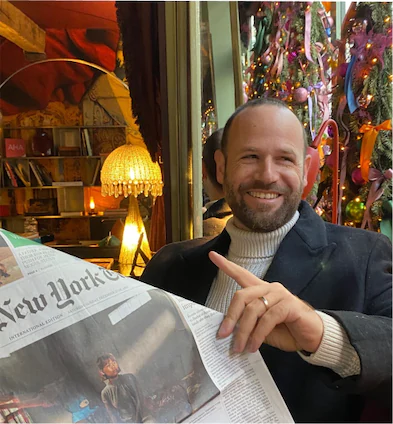
Asaf Peled
Asaf Peled began operating Jewish tours as a registered guide in Israel in 2012, before founding Shin Tours in 2018 and opening up Jewish heritage tours in the Middle East, North Africa and Europe.